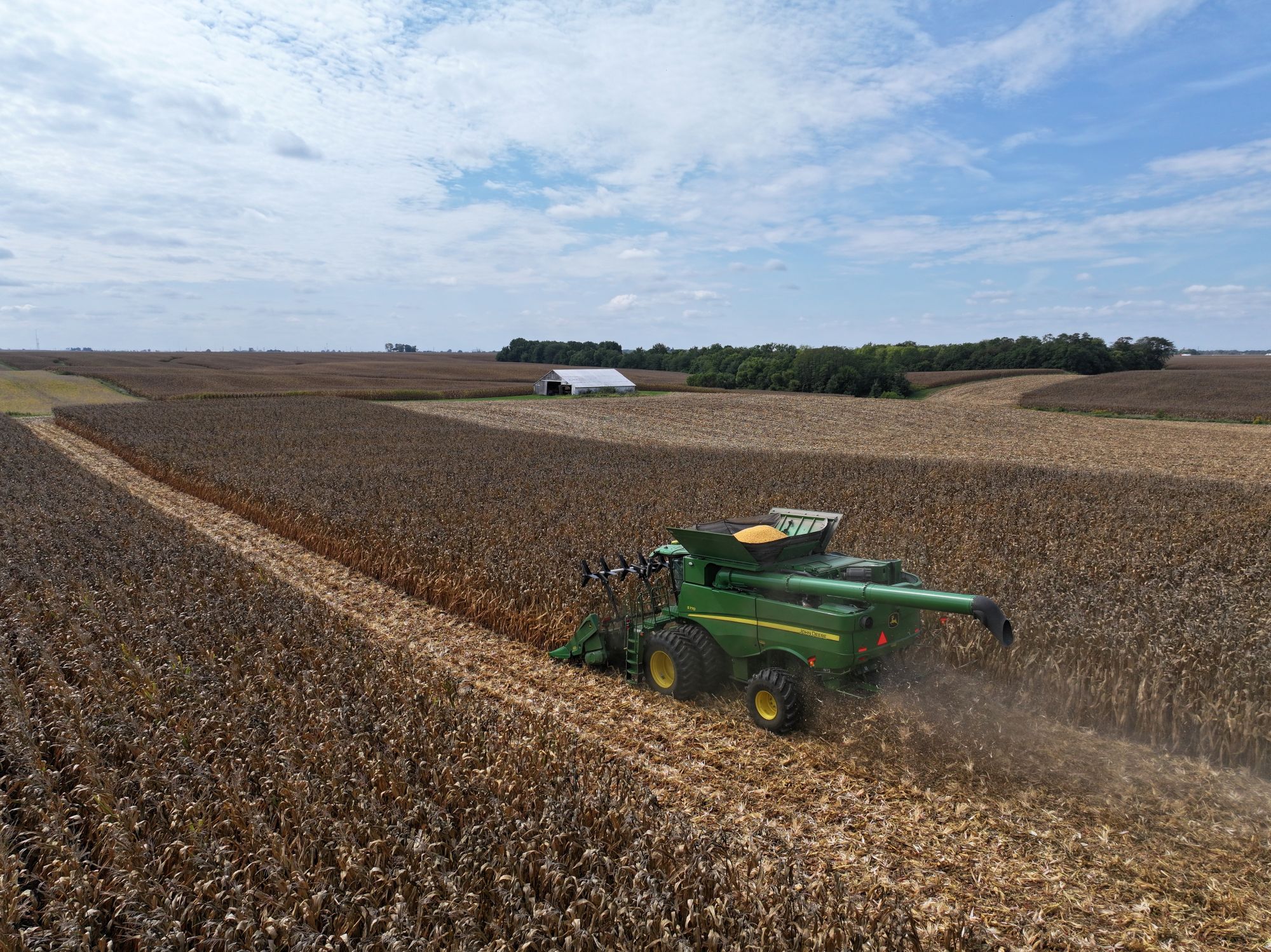
Follow the Farm Journal"Harvest Your Independence Tour" following 6 Midwestern growers and stopping at a different farm each week.
Agronomic Update - 10/16
Harvest has gained serious momentum across the Corn Belt, with growers making up significant ground during one of the best weather stretches of the season. As we enter mid-October, combines are running across much of Nebraska, South Dakota, Illinois, Indiana, Iowa, and Wisconsin, and yield reports continue to roll in. Recent and upcoming rain and strong winds may create temporary slowdowns or challenges in parts of the region, particularly where fields remain vulnerable after September's wet conditions, but forecasts suggest another favorable harvest window is right behind it.
Explore this week's Harvest Progress Report for the latest farmer-submitted updates on yields, harvest activity, and trial highlights from across the region. See below for additional harvest resources. Weekly regional updates will be shared on Thursday & Friday.
Southern WI/Northern IL: It's been another week of steady harvest progress across northern Illinois and southern Wisconsin. Soybean harvest is approximately 75% complete, while corn harvest is just getting underway at 5–10% complete. Early corn yield reports range from equal to last year to 10% below. Cooler, more seasonal temperatures and anticipated rainfall will slow grain drydown and temper harvest progress in the days ahead. - Product Manager, Brent Tharp
Southern Illinois: Harvest continues to move toward harvest completion. Most of the growers in the region are, or will be, finished in the next 7-10 days. Yields remain very strong. Rainfall will slow down growers for a few days.
Western Illinois: Most growers switched to beans in the last week and made great progress. I would estimate 50-60% of bean harvest is complete with many record farm yields being reported especially in the fuller season beans. Corn continues to be highly variable with the pattern tiled and good drainage fields being the best. The June rain hurt the flat black fields with little to no tile more than earlier thought. Yields are off 30-40 bushels per acre in many cases from 2025. I would estimate corn harvest to be 50% complete going between Springfield and the Galesburg area, and 25-30% complete as you move closer to the Quad Cities. - Area Agronomy Manager, Ryan Gentle
Southern MN/Eastern SD: Harvest has been full steam ahead for the last week or two throughout southern MN and eastern SD. Soybean harvest is wrapped up for most operations, though progress has been slightly slower in areas of south central MN and eastern MN where soybean yields have been strong. Most operations in the western areas of my geography switched to corn last weekend (10/10-10/11), with most further east switched to corn by mid-week. So far, yields have been all over the board. Droughty areas of SW MN have been disappointing, while outside the major drought areas yields have ranged from average to very positive (even with reports of yield records!). Overall, we are probably around 30% complete with corn harvest. - Area Agronomy Manager, Jared Goplen
Eastern Iowa: Corn harvest remains slow in eastern IA while many are still working through soybeans. Rain delays continue to be an issue. Soybean yields remain strong and corn that has been harvested has been respectable. Pockets in NE IA that took the most water this growing season are off quite a bit for corn yields. N loss and crown rot plagues these areas. - Area Agronomy Manager, Eric Wilson
Eastern NE/Southwest IA: Growers had a solid week of favorable conditions, and were able to get most of the soybeans harvested. Across SW Iowa, and eastern Nebraska soybean harvest is about 85% complete, with corn being around 10% complete. Soybean yields are above average with corn yields starting out at average, but above expectations in most areas. Some 50-60 mph wind this past weekend did put corn in several counties in north east Nebraska. - Area Agronomy Manager, Andy Swanson
Eastern IL/Western IN: East central IL and Indiana soybean harvest is 75% complete with good progress made in the last week. Many growers are reporting they are now getting back in corn. In the area, corn has dropped 15 points in 12-13 days! I am hearing of some 10-12% grain, even on some 114-day RM hybrids planted in mid-May. Stalks continue to be of concern especially with recent rains and wind. - Area Agronomy Manager, Robby Meeker
Central IA/Northwest IA: Weather conditions finally allowed for farmers to harvest in earnest this last week. The main focus to start was on soybean harvest, as beans were dry enough to be harvested quickly. Soybean yields were mixed across the region, but most were reporting more favorable yields than anticipated given conditions in the 50-70bu range. 80-90% of soybeans are harvested around the region. Corn harvest did start with most farmers. They're taking out the early season hybrids first, or those that may have had tougher conditions due to drought, stalk rots or wind damage. Yields for these fields was lower than expectated due to the tougher conditions. However, as the week progressed and problem fields were completed, yields across the region improved. Corn moistures have dropped to not be a limiting factor or a decision on which fields to harvest for priority. In northwest Iowa and central Iowa we are at about 10%-15% of corn harvested. - Area Agronomy Manager, Mike Witt
Virginia, IL: W7544 takes top honors in the Virginia FIRST Trial, out yielding the trial average by 28.9 bu/A. W5735 finishes top 3 in its respective trial.
Keokuk Co., IA:W7229 (295.6 bu/A), W9097, W7424, and W7819 finish in the top 5 of a 34-entry trial
West Point, NE: W5129RIB tops a 15-entry trial in Cuming County, NE, with W5684RIB and W7544RIB finishing in 2nd and 3rd.
Wright Co., MN: W4545RIB tops a 19-entry trial, with W5684RIB and W4889RIB finishing 2nd and 3rd.
Stanley, IA: W5129RIB tops a 3-brand Buchanan County Trial.
Leaf River, IL: W4545RIB places 1st in two Northern IL trials: a multi-brand trial in Ogle County, IL (249.4 bu/A), and the Grand Ridge ILNO FIRST ultra early-season trial.
Rock Island Co., IL: W9097 tops a third party trial, out yielding the trial average by 22 bu/A.
Shell Rock, IA: W7819RIB tops a 26-entry trial in Butler County, IA, with W6644RIB and W4545RIB finishing in 2nd and 3rd.
Yellow Medicine Co., MN: W3654RIB tops a 24-entry trial, with W5684RIB and W4514RIB finishing in 2nd and 3rd.
Manchester, IA: W4545 and W6644 top their respective tests in a Delaware County FIRST Trial, each out yielding the trial average by 20+ bu/A.
*No product recommendations by F.I.R.S.T. implied.
Get to Know the Wyffels Lineup!
The Wyffels Agronomy Team shares insights on new and top-performing products for 2026.These quick videos walk you through product characteristics, trait details, and best practices for top-end yield.
Harvest has finally found its footing across much of the Corn Belt. After weeks of weather-related delays, growers from Nebraska to Indiana have made significant progress during a favorable stretch of October weather, with combines running steadily and more yield reports coming in by the day. While scattered showers are creating short-term slowdowns in parts of Iowa, Wisconsin, and northern Illinois, the broader harvest picture continues to improve.
Explore this week's Harvest Progress Report for the latest farmer-submitted updates on yields, harvest activity, and trial highlights from across the region. See below for region specific updates and additional harvest resources.
Eastern Illinois/Indiana: This week east central IL and Indiana have been able to run full steam ahead! Soybean yields have continued to be strong relative for the year. Corn yields continue to be lackluster compared to the last couple of years. Soybean harvest has been the main focal point for growers this week, but corn progress has also been made. I'm estimating 20% complete for East Central IL and IN. - Area Agronomy Manager, Robby Meeker
Southern WI/Northern IL: Farmers in southern Wisconsin and northern Illinois took advantage of the nice stretch of weather this week. Soybean harvest is in full swing and some fields of corn are being taken off. The sunshine has brightened moods and is also helping with grain drydown. Bean yield reports have been mostly positive and some early corn results are decent. - Product Manager, Brent Tharp
Eastern Iowa: Eastern IA was finally able to make some progress this week. The majority of growers started on soybeans and yields have been strong. Corn that has been harvested has been respectable but still too early to get solid yield ranges. With a few chances of rain in the coming week everyone is hammer down. - Area Agronomy Manager, Eric Wilson
Southern Illinois: Harvest continues to move along rapidly in this area. Springfield south has missed most of the rain and many growers are seeing or crossed the finish line. Yields of both crops remain very good.
Western Illinois: Corn has finally started to dry down but most growers are taking advantage of the great weather to cut beans. Bean yields have been strong. I'm continuing to hear corn yields are off 10-15% from last year. Fields with natural drainage or pattern tile are leading the pack. - Area Agronomy Manager, Ryan Gentle
Northwest/Central Iowa: Growers were able to finally get started harvesting with speed this week. Most are harvesting soybeans with yield being better than expected. Poor grain quality and stalk integrity may be an issue moving forward but corn is drying and will be ready to harvest as soon as farmers are able to get there. The late week rain will slow some in central Iowa but other parts of the region will continue. Most farmers I spoke with will be switching from beans to corn early next week if possible. Yield results should start to be reported rapidly. Weather conditions look to hold thru mid-next week, which should help most of the region. - Area Agronomy Manager, Mike Witt
Eastern Nebraska/Southwest Iowa: Much like the rest of the Corn Belt, harvest got going in earnest this week in SW Iowa and eastern Nebraska. Farmers harvested fields with concerns about stalk quality, or corn that had already lodged/broken, before moving into soybeans. Several of those fields were up to 40 bushels off of comparable standing corn. Forecasted winds for this weekend should be cause for taking another look at stalk conditions to prioritize harvest order. - Area Agronomy Manager, Andy Swanson
Southern Minnesota/Eastern South Dakota: Harvest has progressed very rapidly this week. While soils were drying out, some operations took a field or two of corn out last week on Friday and Saturday before switching into soybeans. Most operations have been going hard on soybeans all week with the favorable weather. Soybean yields are variable depending on seasonal precip but overall most are surprised (in a good way) on what they are seeing. Early corn yield reports are sparse, but the field reports and plots look to be very strong in the areas that got timely rainfall. In these areas I expect above average yields, but in SW MN (the heart of the drought) yields have been disappointing. Corn has dried down substantially in the past week with most corn in the low 20s or drier, with the early hybrids getting down to 15% or lower now, so once operations wrap up beans it will be straight into corn. - Area Agronomy Manager, Jared Goplen
Virginia, IL: W7544 takes top honors in the Virginia FIRST Trial, out yielding the trial average by 28.9 bu/A. W5735 finishes top 3 in its respective trial.
Keokuk Co., IA:W7229 (295.6 bu/A), W9097, W7424, and W7819 finish in the top 5 of a 34-entry trial
Wright Co., MN: W4545RIB tops a 19-entry trial, with W5684RIB and W4889RIB finishing 2nd and 3rd.
Stanley, IA: W5129RIB tops a 3-brand Buchanan County Trial.
Leaf River, IL: W4545RIB places 1st in two Northern IL trials: a multi-brand trial in Ogle County, IL (249.4 bu/A), and the Grand Ridge ILNO FIRST ultra early-season trial.
Rock Island Co., IL: W9097 tops a third party trial, out yielding the trial average by 22 bu/A.
Shell Rock, IA: W7819RIB tops a 26-entry trial in Butler County, IA, with W6644RIB and W4545RIB finishing in 2nd and 3rd.
Yellow Medicine Co., MN: W3654RIB tops a 24-entry trial, with W5684RIB and W4514RIB finishing in 2nd and 3rd.
McLean, IL: W7544 tops a McLean County trial, out yielding the trial average by 32.7 bu/A. W9097 and W7485RIB also finish in the top 5.
*No product recommendations by F.I.R.S.T. implied.
Keeping It Independent Podcast
Get to Know the Wyffels Lineup!
The Wyffels Agronomy Team shares insights on new and top-performing products for 2026.These quick videos walk you through product characteristics, trait details, and best practices for top-end yield.
After weeks of rain delays, harvest finally looks ready to hit another gear. A couple of drier days have helped growers begin working back into fields, and a promising stretch of harvest weather could open the door to significant progress across the Corn Belt this week. While wet soils continue to slow some areas, particularly across Iowa and eastern Nebraska, the bigger focus is shifting toward prioritizing fields as concerns around stalk integrity, ear rots and grain quality linger.
Explore this week's Harvest Progress Report for the latest farmer-submitted updates on yields, harvest activity, and trial highlights from across the region.
Central/Eastern Illinois: Harvest progress has been slow across Central Illinois due to cloudy conditions and persistent mist that have limited field activity. Corn moisture levels have been stubborn, with April-planted corn actually gaining a point or two in moisture this week. Most May-planted corn remains around 25% moisture across hybrids. Drydown has been much slower than expected, but with a favorable weather pattern moving in, we're hopeful for improved conditions that can help remove a few more moisture points and allow growers to get back into fields, especially in areas that received significant rainfall. Some plots were harvested this week from Bloomington southward, and results from several new products have been exciting. W7544, W7229 and W9097 have been the standout rookies. W7945 continues to demonstrate why it remains a leader in the lineup, delivering impressive yield performance and reinforcing its strong reputation across the region. - Area Agronomy Manager, Robby Meeker
Southern WI/Northern IL: Harvest began in parts of northern Illinois and southern Wisconsin, but progress was stopped due to rain. It’s still too early to get a good idea on yield levels. I expect solid, but not record yields. We should see better yields than last year in areas that experienced high disease pressure. It appears we might get a much-needed dry window after this rain system moves through. Expect grain drydown rates to slow as we move into October, lose daylight, and temperatures cool. - Product Manager, Brent Tharp
Southeast Iowa: Harvest progress remains mostly stagnant across E Iowa. Conditions continue to remain wet. The outlook for next week looks hopeful, but this will be dependent on totals from recent rainfall across the area. Stalks remain intact for now, however, we have been lucky to miss any wind events. Grain moisture from hand shelled corn is coming in at the low 20s. I am receiving widespread concern on kernels germinating on the ear across the area. This is a fairly common occurrence. In most cases this is not impacting a large percentage of the ear. - Area Agronomy Manager, Eric Wilson
Southern Illinois: Harvest continues to move along rapidly in this area. Springfield south has missed most of the rain and many growers are seeing or crossed the finish line. Yields of both crops remain very good.
West Central Illinois: It's still a very mixed bag of progress and yields. Some growers are at 30% done on corn, while others have yet to start. First week of May planted corn is still hanging in the 19-22% range and many are waiting to harvest. Yields are highly variable, as well. The flat black fields might not be the best this year. The rolling fields are doing well. I'm hearing a lot of 10-20% off last years’ record yields. Most of this area received 1-2 inches of rain, so it will be the October 5th timeframe before harvest resumes. - Area Agronomy Manager, Ryan Gentle
Northwest/Central Iowa: Harvest progress is at a standstill in central and northwest Iowa. Rainfall has kept farmers out of fields and most are going to be unable to do field work for a while given the 1-4 inches of rain accumulation. Ear rots and vivipary are becoming more widespread, and stalk integrity is still holding. Moistures have remained stagnant in the high teens to low 20’s. Weather patterns need to shift before farmers are able to make it back to the fields. Prioritization of fields to harvest will be a key concern moving forward.
Eastern Nebraska/Southwest Iowa: Most places in the area received anywhere form 1” up to 6” of rain this week, causing further delays in harvest. We have been lucky not to have received much wind with these systems as concerns of stalk quality, ear rots, and vivipary (sprouting on the ear) increase with each day. Grain moisture has ticked up 3-4 points since the start of this rainy spell of the past two weeks. Very few growers were able to take advantage of a rainless day this past Monday, and harvest has been very slow. The week ahead looks to be without any precipitation in the forecast, and I expect many long days and nights ahead. - Area Agronomy Manager, Andy Swanson
Southern Minnesota/Eastern South Dakota: The past week has been wet throughout the area which has resulted in almost no new harvest activity. The drought-affected areas of southwestern MN and Eastern SD continue to see stalk quality degrade, with significant standability concerns in some cases. Corn was ranging from 18 - 30% prior to the rain this week and sticking around that level until we start to dry out again. Most hybrids have now black layered, aside from some of the full season hybrids or late planted corn. Hopefully, we'll start to dry out next week so we can get a good start on the crop!
Grundy Co., IL: W9097RIB tops a 12-entry trial with W7876RIB and W7229RIB finishing in 3rd and 4th.
Keokuk Co., IA:W7229 (295.6 bu/A), W9097, W7424, and W7819 finish in the top 5 of a 34-entry trial
Leaf River, IL: W4545RIB places 1st in two Northern IL trials: a multi-brand trial in Ogle County, IL (249.4 bu/A), and the Grand Ridge ILNO FIRST ultra early-season trial.
Cedar Co., IA: W7424RIB tops an 11-entry trial with W7229RIB and W7876RIB finishing 2nd and 3rd.
Edgerton, MN: W2557, W4487, W6479, W5684, W4514 top 5 hybrids in a 24-entry drought stressed plot
McLean, IL: W7544 tops a McLean County trial, out yielding the trial average by 32.7 bu/A. W9097 and W7485RIB also finish in the top 5.
Oakville, IA: W7499 (258 bu/A) and W7424 (251) finished in top 5 of a 14 entry multi-brand trial
St Charles, MO: W6644 (300 bu/A), W7424 (295), W7945 (295), W8086 (294) finished in the top 10 of a 20 entry multi-brand trial
*No product recommendations by F.I.R.S.T. implied.
Get to Know the Wyffels Lineup!
The Wyffels Agronomy Team shares insights on new and top-performing products for 2026.These quick videos walk you through product characteristics, trait details, and best practices for top-end yield.
Harvest is entering its first major push across the central Corn Belt, but progress remains uneven as many areas continue working through the effects of a wet September. Across Iowa, southern Minnesota, eastern Nebraska, southern Wisconsin, and eastern South Dakota, much of the crop has reached maturity and silage harvest is largely complete. However, persistent rainfall and saturated soils have slowed field activity, with some Iowa regions reporting flooding, delayed harvest, and growing concerns around stalk integrity, ear rots, and grain quality. Early yield reports continue to be encouraging, but many growers are waiting for field conditions to improve before making significant harvest progress.
Illinois and western Indiana have generally made more harvest progress, although recent rains have created another round of delays. University of Illinois Extension reports combines have been running sporadically, with many corn fields at black layer and moisture levels falling into the upper teens to upper twenties. Agronomists continue to note lodged corn, hybrid-specific standability issues, and localized ear rot pressure. Once fields dry, harvest activity is expected to ramp up quickly heading into October.
Looking ahead, several regions are expected to receive a favorable harvest window before another round of precipitation arrives later this week. Farmers should use dry periods to assess stalk quality, perform push tests, monitor ear molds, and determine harvest order. Fields showing lodging potential, crown rot, ear rot, or grain-quality concerns should move to the front of the harvest schedule. Where grain condition is questionable, harvesting at slightly higher moisture and investing in drying may help protect yield, test weight, and marketability as harvest accelerates across the region
Central/Eastern Illinois: Harvest progress has been slow across Central Illinois due to cloudy conditions and persistent mist that have limited field activity. Corn moisture levels have been stubborn, with April-planted corn actually gaining a point or two in moisture this week. Most May-planted corn remains around 25% moisture across hybrids. Drydown has been much slower than expected, but with a favorable weather pattern moving in, we're hopeful for improved conditions that can help remove a few more moisture points and allow growers to get back into fields, especially in areas that received significant rainfall. Some plots were harvested this week from Bloomington southward, and results from several new products have been exciting. W7544, W7229 and W9097 have been the standout rookies. W7945 continues to demonstrate why it remains a leader in the lineup, delivering impressive yield performance and reinforcing its strong reputation across the region. - Area Agronomy Manager, Robby Meeker
Southern WI/Northern IL: Harvest has begun in parts of northern Illinois and southern Wisconsin. It’s still too early to get a good idea on yield levels. I expect solid but not record yields and better yields than last year in areas that experienced high disease pressure. It appears we might get a much-needed dry window after this rain system moves through. Expect grain dry-down rates to slow as we move into October and lose daylight and temperatures cool. - Product Manager, Brent Tharp
Southeast Iowa: Progress remains slow to none. Persistent damp conditions have kept combines out of the field. We're seeing positive yield results in pockets that have been able to go, however stalk quality has been a concern.
Northeast Iowa: With less rain and better drying weather, some action started mid to late week. Yield results on early numbers such as W2674 and W3654 have been very positive! Harvest will continue as long as rains hold off. - Area Agronomy Manager, Eric Wilson
Southern Illinois: Progress continues to chug right along south of the Springfield area with yields remaining high. Some growers are reporting best ever corn yields. Many growers are approaching the finish line on corn harvest in this area.
West Central Illinois: Progress continues at a much slower pace around the Peoria/Galesburg area. Many growers took advantage of the warnings from their seed dealers and went out and got fields with stalk rots and compromised stalks in the last couple of weeks. Many growers are still sitting on the sidelines waiting for corn to dry down. May corn is still in the 24-27% moisture range in many fields and we experienced several days of drizzle and clouds. Early yields have been pretty good with many farmers reporting 10-20 bushels off last years’ record corn crop. Wyffels has been very strong in early plots. W7945, W7876, W7544, W6644, & W8134 have all looked very good in the early batch of plots. - Area Agronomy Manager, Ryan Gentle
Northwest/Central Iowa: The area has received anywhere from 1-3 inches of rain over the last week. With cool and wet conditions, no new field work was reported across the area. Drydown is progressing slowly across the region with more rain expected. Farmers are prepared to harvest when conditions improve. Corn moistures remain in the 17-30% moisture ranges depending on hybrid maturities.
Eastern Nebraska/Southwest Iowa: With some amount of moisture every day for the past week, not much progress has been made on harvest. Some operations were able to get out mid week, but that was the exception, not the rule. Fields that were down to 16% moisture before the rain gained a few points of moisture, and are testing around 18-20%.
Southern Minnesota/Eastern South Dakota: The past week has been wet throughout the area which has resulted in almost no new harvest activity. The drought-affected areas of southwestern MN and Eastern SD continue to see stalk quality degrade, with significant standability concerns in some cases. Corn was ranging from 18 - 30% prior to the rain this week and sticking around that level until we start to dry out again. Most hybrids have now black layered, aside from some of the full season hybrids or late planted corn. Hopefully, we'll start to dry out next week so we can get a good start on the crop!
Keokuk Co., IA:W7229 (295.6 bu/A), W9097, W7424, and W7819 finish in the top 5 of a 34-entry trial
Clarinda IA: W7876 (250), W7424 (250 bu/A), W6644 (249), W7229 (248), W7819 (243) top 5 hybrids in a 16-entry trial
Edgerton, MN: W2557, W4487, W6479, W5684, W4514 top 5 hybrids in a 24-entry drought stressed plot
McLean, IL: W7544 tops a McLean County trial, out yielding the trial average by 32.7 bu/A. W9097 and W7485RIB also finish in the top 5.
Sigel, IL: W9097, W7544, and W7485RIB finish top 3 in a Cumberland County Trial.
Oakville, IA: W7499 (258 bu/A) and W7424 (251) finished in top 5 of a 14 entry multi-brand trial
St Charles, MO: W6644 (300 bu/A), W7424 (295), W7945 (295), W8086 (294) finished in the top 10 of a 20 entry multi-brand trial
Percival, IA: W6644 top $/A hybrid in 20 entry trial
Get to Know the Wyffels Lineup!
The Wyffels Agronomy Team shares insights on new and top-performing products for 2026.These quick videos walk you through product characteristics, trait details, and best practices for top-end yield.
Combines are starting to move, especially in southern/western Illinois, but overall progress remains minimal for now. For most of the region, corn maturity is ahead of schedule. Conditions remain somewhat uneven due to localized weather extremes, but we are expecting an earlier harvest for many corn growers. Rain has slowed down progress for many this week, but once things dry out, we expect to see a lot of combines rolling!
Regional Updates (As of 9/19)
Western IL: Harvest has begun in western Illinois! Many growers south of the Springfield area have gotten a good start on corn harvest. We're hearing many record yield reports from Springfield to St. Louis, with it being better the farther south you go. Growers from Springfield to Peoria are just getting started. Most of the fields in this area have been pretty good if they didn’t die prematurely. We have seen some fields experience early dieback due to crown rot. Most of these fields have yielded around 200 bu/ac, while the healthier, greener fields have generally ranged from 230 to 260 bu/ac. Growers from Galesburg north haven’t had a chance to do much corn harvest yet. Most of the area received anywhere from 1.5-3 inches of rain on 9/15, so it will be a few days before combines can begin to roll again. Once it dries out, I believe harvest will kick into full swing. - Area Agronomy Manager, Ryan Gentle
Southern WI/Northern IL: Very few corn fields have been harvested for grain in SOWI/NIL, while silage harvest is well underway. Tonnage reports are variable and generally trending below last year. This week’s rain will keep farmers out of the field and provides favorable conditions for continued development of stalk and ear rot pathogens. Now is the time to get into fields and evaluate stalk and ear quality to help determine harvest timing and prioritize fields at risk for further deterioration. - Product Manager, Brent Tharp
Eastern IA: Very little corn harvest has taken place on the east side of the state. Many were hoping to start this last week, but wet weather has kept everyone sidelined. Of the few that have been able to go early, yield reports have been solid but it's still to early to establish any trends. Silage estimates have come in over the spread of 200-300 BPA. A few early beans have come out and reports have been very good. Many are hoping to start next week once field conditions dry out. Stalk integrity remains a concern, especially after a week of wet weather. - Area Agronomy Manager, Eric Wilson
Eastern IL / Western IN: Harvest in east central IL kicked off here in the middle of September. Variability is the name of the game in terms of moisture and yields. Moisture ranges in field are commonly 5% and yield well over 100 bushel. I would guess that 20% of east central IL growers tried out the combine this week. It feels like it's too early to tell much, but many growers think yields will be off 10% year-over-year. In Indiana, corn harvest is limited. I haven't heard many reports other than early maturity corn, but soybeans are delivering solid early yields. - Area Agronomy Manager, Robby Meeker
Southern MN / Eastern SD: Across southern MN and Eastern SD you can find it all. A poor, drought-stricken crop in SW MN and parts of eastern SD, and corn that’s still green and packing on mega yields in south central MN. In SW MN and eastern SD harvest has just begun. This area has been battling significant drought conditions the last half of summer, which caused the crop to shut down prematurely and to start deteriorating rapidly. The hot, windy conditions last week and the occasional early fall storm hasn’t helped the cause. Stalks were cannibalized trying to fill the ear in these areas, and stalk quality is very poor. Early yield reports in drought-stricken fields are very poor, with about half of a normal crop being harvested. Some farms are taking out some tough-looking corn before starting soybeans. Overall harvest progress is maybe 2% complete and likely to come to a halt for a week as rain moves through. Once you get outside the droughty areas there will be some record corn yields in southern MN and eastern SD! The crop looks excellent in south central and most of SE MN, as well as a pocket south of Watertown, SD. Harvest has been very slow to start in these areas. The early yield reports I’ve heard are impressive and in the range of 260bpa+ for early maturities! - Area Agronomy Manager, Jared Goplen
Eastern NE / Southwest IA: Southern areas of the region are rolling on harvest, or at least they were until this latest rainy spell. Many growers were going on high moisture corn or getting fields out where stalk integrity was a concern. It’s too early to put a yield trend together, but seed corn harvest is well underway, and yields are above average, which is usually a good indicator of what commercial fields will yield. While we wait for things to dry out, I would encourage growers to get out and do some push and pinch tests on stalks to gauge stalk integrity to help develop a harvest plan. - Area Agronomy Manager, Andy Swanson
Northwest Iowa: Harvest is in the beginning phases with most corn still above 25% moisture readings. Some early maturity (95-98 RM) hybrids are starting to be harvested due to the droughty conditions in the late summer and over 200 GDU’s above average in the region. Rainy conditions in September have slowed farmers progress on these fields but they are getting done. Silage chopping across the region is also in process with many fields already harvested. W7870 and W7759 have been proving to be excellent high yielding choices across the area. High moisture corn fields have started to be harvested in smaller quantities across the region as well.
North Central / Central Iowa: Less than 1% of corn fields are being reported as harvested. Many farmers are preforming moisture checks and fields are at too high moisture to harvest. Early harvest reports are for fields at high moisture harvest levels or early RM hybrids. Rainfall in the area will push majority of harvest back at least a week. - Area Agronomy Manager, Mike Witt
Clarinda IA: W7876 (250), W7424 (250), W6644 (249), W7229 (248), W7819 (243) top 5 hybrids in a 16-entry trial
Edgerton, MN: W2557, W4487, W6479, W5684, W4514 top 5 hybrids in a 24-entry drought stressed plot
New Athens, IL: W9097 (259), W7819 (256), W8086 (254) finished in the top 5 of a 20-entry trial
Oakville, IA: W7499 (258) and W7424 (251) finished in top 5 of a 14 entry multi-brand trial
St Charles, MO: W6644 (300), W7424 (295), W7945 (295), W8086 (294) finished in the top 10 of a 20 entry multi-brand trial
Percival, IA: W6644 top $/A hybrid in 20 entry trial
"Keeping It Independent" Podcast
On this week's podcast, the Wyffels Agronomy Team talks early yield results, crown rot updates, and harvest timing considerations.
Get to Know the Wyffels Lineup!
The Wyffels Agronomy Team shares insights on new and top-performing products for 2026.These quick videos walk you through product characteristics, trait details, and best practices for top-end yield.
Welcome to the 2026 Harvest Progress Report. Combines are moving in certain corners of the Corn Belt, but progress remains minimal for now. For most of the region, corn maturity is ahead of schedule. Conditions remain somewhat uneven due to localized weather extremes, but we are expecting an earlier harvest for many corn growers.
Check back later in the week for detailed regional updates from our Agronomy team.
Recent Trial Highlights
Clarinda IA: W7876 (250), W7424 (250), W6644 (249), W7229 (248), W7819 (243) top 5 hybrids in a 16-entry trial
Edgerton, MN: W2557, W4487, W6479, W5684, W4514 top 5 hybrids in a 24-entry drought stressed plot
New Athens, IL: W9097 (259), W7819 (256), W8086 (254) finished in the top 5 of a 20-entry trial
Oakville, IA: W7499 (258) and W7424 (251) finished in top 5 of a 14 entry multi-brand trial
St Charles, MO: W6644 (300), W7424 (295), W7945 (295), W8086 (294) finished in the top 10 of a 20 entry multi-brand trial
It's the final stretch of harvest 2025 in the Central Corn Belt! Most farmers in Illinois and Iowa are either done or nearing the end of corn harvest. As you go north toward Minnesota and Wisconsin, progress becomes scattered. Some farmers are already done with corn, while others still remain closer to 50%.
Yield results remain highly variable and localized. Disease management continues to be the biggest factor in those returns. The majority of the region is seeing 200-250 bu/A, with outliers popping-up across the map. West central Illinois is seeing the highest yields (averaging closer to 250-275), and some growers in SW Minnesota are seeing their best results ever.
While the weather has cooled in recent weeks, the hot and dry start to October made stalk integrity issues common across the Corn Belt, especially in fields with heavy disease pressure.
--------
On this week's "Keeping It Independent" podcast, the Wyffels agronomy team discusses harvest progress, yield component analysis, fall fertilizer, and more. Watch HERE.
On this week's AgDay, they visit Wyffels grower and seed rep Mike Madsen who is finishing up harvest on a bumper corn crop in southern Minnesota. Watch HERE.
Corn trial yield results are coming in from across the Corn Belt! Explore individual trial results and gain insights on what's yielding - and how products are performing in specific environments. View Results.
We're entering the final stretch of harvest across the Corn Belt. Most farmers in Illinois and Iowa are either done or nearing the end of corn harvest. As you go north toward Minnesota and Wisconsin, progress becomes scattered. Some farmers are already done with corn, while others remain closer to 50%.
Yield results remain highly variable and localized. Disease management continues to be the biggest factor in those returns. The majority of the region is seeing 200-250 bu/A, with outliers popping-up across the map.
While the weather has cooled in recent weeks, the hot and dry start to October accelerated plant drydown. As a result, stalk integrity issues are common across the Corn Belt, especially in fields with heavy disease pressure.
--------
On this week's "Keeping It Independent" podcast, the Wyffels agronomy team discusses harvest progress, yield component analysis, fall fertilizer, and more. Watch HERE.
On this week's AgDay, they visit Wyffels grower and seed rep Mike Madsen who is finishing up harvest on a bumper corn crop in southern Minnesota. Watch HERE.
Corn trial yield results are coming in from across the Corn Belt! Explore individual trial results and gain insights on what's yielding - and how products are performing in specific environments. View Results.
We're entering the "dog days" of harvest across the Corn Belt. Farmers in Illinois and Iowa are nearing the end of corn harvest. As you go north toward Minnesota and Wisconsin, progress becomes variable. Some farmers are already done, while others remain closer to 50%.
Yield results remain highly variable and localized. Disease management and weather conditions continue to be the biggest factor in those returns. The majority of the region is seeing 200-250 bu/A, with outliers popping-up across the region.
While the weather is finally feeling like fall, the hot and dry start to October accelerated plant drydown. As a result, stalk integrity issues are common across the map, especially in fields with heavy disease pressure.
--------
On this week's "Keeping It Independent" podcast, the Wyffels agronomy team discusses harvest progress, yield component analysis, fall fertilizer, and more. Watch HERE.
In southern Wisconsin, Wyffels grower Casey Kelleher has been battling the weather late this season, but his corn yields are still pacing ahead of last year. Watch HERE.
Corn trial yield results are coming in from across the Corn Belt! Explore individual trial results and gain insights on what's yielding - and how products are performing in specific environments. View Results.
Harvest is in full swing across the Corn Belt. Farmers in Illinois and Iowa are about at the half way point of corn harvest. As you go north toward Minnesota and Wisconsin, progress is variable. Some farmers are nearing completion, while others remain below 25%.
Yield results remain highly variable and localized. Disease management and weather conditions continue to be the biggest factor in those returns. The majority of the region is seeing 200-250 bu/A, with outliers popping-up across the region.
While the weather has finally cooled down, the hot and dry start to October accelerated plant drydown. As a result, stalk integrity issues are common, especially in fields with heavy disease pressure.
As we enter October, harvest is rolling across the Corn Belt. Most farmers are still below 25% done with corn harvest, but there are pockets of greater progress in southeast Iowa and western Illinois.
Recent hot and dry conditions have accelerated plant drydown and harvest progress. As a result, stalk integrity issues are popping-up, especially in fields with heavy disease pressure.
Yield results remain variable, and disease management continues to be the biggest factor in those returns. The majority of the region is seeing 200-250 bu/A, with positive outliers in western Illinois.
Combines are rolling in the southern Corn Belt after a hot and dry end to the growing season, while northern portions of the region are still seeing limited action.
Early yield results are variable. Disease management is the primary conversation so far this fall. Fields where disease was managed effectively have been good, while those where disease got out-of-control have suffered.