Customize your wyffels experience

You don’t have to work for wyffels to be an insider
Get access to exclusive agronomic content, product downloads and more.
Brand
• Great combination of strong agronomics and top-end yield potential
• Strong roots and stalks and very good Goss’ tolerance
• Maintains late season health for a later harvest
• Flex ear works over a wide range of populations

These ratings are useful as indicators of potential product performance under normal conditions. They should not be considered a guarantee of future performance.
Widely adapted hybrid with excellent agronomic characteristics. Works well over variable conditions. Full flex ear provides planting rate flexibility. Above average tar spot tolerance.
| Rating | Soil Category |
|---|---|
| E |
Light SoilsLOW CEC (<10); OM <1.5%; low water-holding capacity; non-irrigated sand; timber soils; marginal productivity; drought prone. |
| E |
Medium SoilsCEC 11–18; OM 1.5-3.5%; well-drained; silt loam; high productivity. |
| E |
Dark SoilsHIGH CEC (>18); OM >3.5%; well-drained; dark colored soils. |
| E |
Poorly-drained SoilsSoils that have the potential to remain saturated for prolonged periods; side hill seeps; gumbo; muck. |
| Legend | ||||
|---|---|---|---|---|
EExcellent |
VGVery Good |
GGood |
FFair |
|
| Trait(s) | CONV |
|---|---|
| GDUs to Black Layer | A, 2690 |
| Days to Pollination | 74 |
| GDUs to Pollination | L, 1370 |
| Early Vigor | 8 |
| Early Canopy | |
| Plant Height | MT |
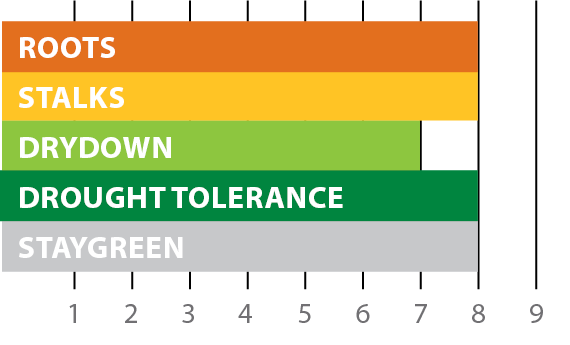
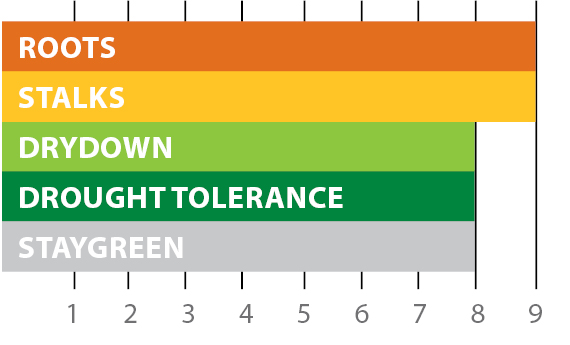
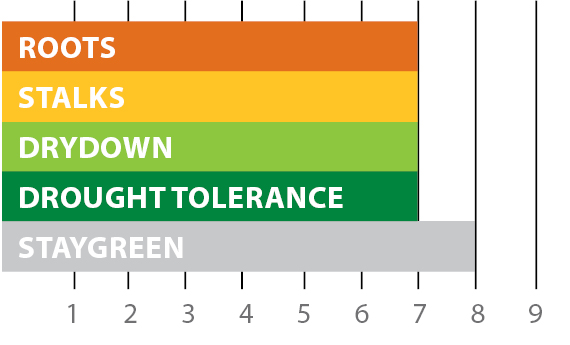
| Stalk Strength | 8 |
| Root Strength | 8 |
| Green Snap Resistance | 8 |
| Drought Tolerance | 8 |
| Staygreen | 8 |
| Rimsulfuron Tolerance |
|---|
| Ear Flex | F |
|---|---|
| Ear Length | 7 |
| Ear Height | MH |
| Kernel Rows | 16-18 |
| Test Weight | 7 |
| Drydown | 7 |
| Goss’ Wilt Tolerance | 8 |
|---|---|
| Gray Leaf Spot Tolerance | 7 |
| NLB, Race 0, Tolerance | 7 |
| Stewarts Leaf Blight Tolerance | |
| Anthracnose Tolerance | 8 |
| Legend | Numerical ratings are based on comparisons among Wyffels hybrids of like maturity where 1 = Low, 5 = Avg, and 9 = High expressions of a trait | ||||||||
|---|---|---|---|---|---|---|---|---|---|
EEarly for Maturity |
AAverage |
LLate for Maturity |
MMedium |
MSMedium Short |
MTMedium Tall |
TTall |
HHigh |
MHMedium High |
MLMedium Low |
FFlex |
SFSemi-Flex |
DDeterminate |
SDSemi-Determinate |
HRHighly Recommended |
RRecommended |
NNormal Tolerance |
CCaution |
WWarning |
NRNot Rated |
• Easy to place hybrid that fits all acres.
• Outstanding stalk strength and very low green snap risk
• Excellent staygreen and solid agronomics make this hybrid a late harvest option
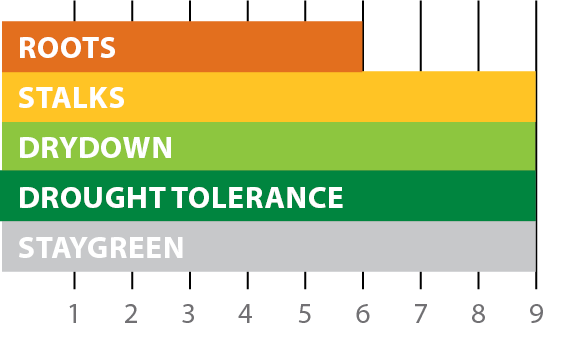
• Top-end yield potential with easy placement across soil types
• Late harvest option with great plant health and standability
• Semi-flex ear with deep kernels and excellent test weight